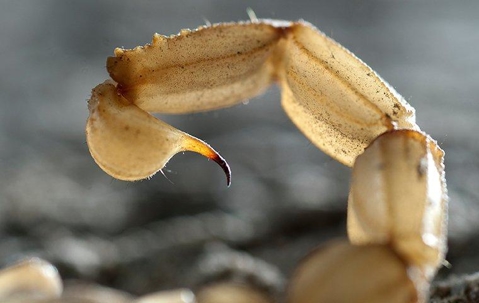
If you’ve just discovered a baby scorpion in your Nevada home, you’re likely asking the urgent questions: how dangerous is it? and what to do if you find a scorpion in your house?
Scorpions in Nevada, especially in and around Las Vegas, include species whose babies may be just as likely to sting as adults. Yet while a sting can be painful, fatalities are extremely rare, particularly when prompt medical care is available.
This guide will help you immediately identify what you’ve found, understand the real risks, and take the safest next steps.
What Does a Baby Scorpion Look Like?
- Size: At birth, baby scorpions (sometimes called scorplings or nymphs) generally measure 0.5 to 1 inch (12–25 mm) in total length, including tail segments.
- Color progression: They usually start as white to translucent, gradually taking on a pale yellow hue, and eventually adopting the adult scorpion’s typical coloration (tan to light brown for bark scorpions).
- Physical features: Even as infants, they display all the core scorpion traits, including eight legs, pincers (pedipalps), and a segmented tail with a stinger.
- Size comparison: Imagine a grain of rice or a pencil eraser. That’s about the scale of many newborn scorpions.
- Local species: In Nevada, the most common species is the Bark Scorpion (Centruroides), whose babies share the slender build of adults.
Since they’re so small and often pale, baby scorpions can go unnoticed, which is why spotting one is a signal to actively search for more.
Are Baby Scorpions More Dangerous Than Adults?
The venom concentration in baby scorpions is believed to be similar to that of adults, but because they are much smaller, they inject smaller doses. In essence: same potency, less quantity.
In Nevada and the Southwest U.S., most serious envenomation cases are tied to the Arizona bark scorpion (Centruroides sculpturatus) and its close relatives. In fact, of the ~185,402 scorpion exposures reported to U.S. poison control, Nevada accounted for ~4.2%.
Nevertheless, vulnerable groups, young children, the elderly, or immunocompromised individuals are at higher risk of complications. Among scorpion stings in children under age 10 in Arizona and Nevada, systemic effects were more common, along with a higher rate of hospital or ICU admissions. Thankfully, historically in the U.S., there have been only a handful of confirmed deaths from scorpion stings over many decades.
So, while baby scorpions are not necessarily more dangerous, their small size makes detection harder and potentially stings more likely to be unnoticed or untreated.
Can Baby Scorpions Sting You?
Yes, baby scorpions are capable of stinging within hours of birth. Their stingers and venom glands mature early enough to deliver a defensive sting. While the venom dose is smaller, the neurotoxins are similar to adult venom in mechanism.
See also the general scorpion venom profile in Medscape’s scorpion envenomation review.
Symptoms of a bark scorpion (Centruroides) sting in Nevada may include:
- Intense, sharp localized pain.
- Swelling, redness, and warmth around the site.
- Tingling, numbness, or involuntary muscle twitching.
- In more severe cases, difficulty swallowing, muscle spasms, respiratory distress.
When to seek medical attention:
- If symptoms progress (e.g. spreading numbness, breathing difficulty).
- If the person stung is a child under 5 or elderly.
- If systemic signs (drooling, convulsions, muscle rigidity) appear.
Always err on the side of caution, especially in high-risk groups.
Treatment protocols generally include:
- Cleaning the sting site and applying a cold compress.
- Pain management.
- Monitoring for systemic symptoms.
- Administering antivenom if warranted and available, in more severe cases). Clinical pediatric case series of bark scorpion envenomation gives insight into protocols.
In most cases, a controlled sting from a scorpion, even a baby, causes local symptoms manageable at home or with outpatient care.
How Many Babies Do Scorpions Have?
Bark scorpions in the Centruroides genus typically give birth to 15 to 35 babies per litter, depending on environmental conditions. Scorpions are live-bearers (viviparous), meaning they do not lay eggs. The gestation period can last 7 to 12 months, influenced by temperature and food availability. In a favorable climate like Nevada’s, a scorpion may produce 1 to 2 litters per year.
So if you find one baby scorpion, there’s a strong chance many siblings and a mother are nearby.
Scorpion Babies on Mother’s Back: Behavior and Timeline
Female scorpions carry their newborns on their back until the babies undergo their first molt. This maternal behavior offers protection, temperature regulation, and moisture control.
In climates like Nevada’s, babies typically remain on the mother for 10 to 14 days before dispersing. Once independent, they go off to hunt small prey or hide in crevices. If you observe baby scorpions around your home, it indicates a breeding female was present and probably nearby.
Peak breeding season runs April through October, so sightings increase during those months.Recognizing this behavior tells you that catching a lone baby may only be the tip of the infestation. Learn more about where scorpions hide in Las Vegas homes.

Baby Scorpions vs Pseudoscorpions (False Scorpions)
Many people mistake pseudoscorpions, sometimes called false scorpions, for baby scorpions because of their tiny size and pincer-like front legs. The key difference is that true baby scorpions have a curved tail with a stinger, while pseudoscorpions do not have a tail or stinger at all.
Baby scorpions are typically elongated and segmented, reaching about half an inch to an inch long in their early stages. Pseudoscorpions are much smaller, only 2 to 8 millimeters long, and have a pear-shaped body.
Their habitats also differ. Baby scorpions can be found indoors and outdoors, hiding in cracks, crevices, and other dark spaces. Pseudoscorpions typically live outdoors in soil or leaf litter and are rarely seen inside homes.
Perhaps the most important difference is risk: baby scorpions are venomous and capable of stinging, while pseudoscorpions are harmless to humans. If you spot a tiny creature with pincers but no tail or stinger, you’re likely looking at a harmless pseudoscorpion.
I Found a Baby Scorpion in My House — What Should I Do?
Immediate takeaway: Discovering one baby scorpion suggests 15–35 siblings plus a mother within ~25 feet is likely.
Step-by-step Plan
- Don’t crush it. Doing so may release alarm pheromones that attract others.
- Safely remove using a glass jar, trap-and-slide method, or gloved container.
- Conduct a systematic search of corners, crevices, baseboards, plumbing penetrations, and dark spots.
- Seal entries like cracks, gaps in doors/windows, and wall penetrations.
- Reduce clutter & moisture. Scorpions are drawn to insects and damp areas.
- Contact a professional to address the infestation.
Quick action is your best defense against a growing scorpion presence.
Frequently Asked Questions About Baby Scorpions
Are baby scorpions poisonous?
Yes, baby scorpions are venomous from birth. In species like the Nevada bark scorpion, venom glands are functional immediately. Fatal stings are extremely rare.
How big is a baby scorpion?
They measure 0.5 to 1 inch long at birth, and can grow to 2–3 inches over 6–12 months.
Do baby scorpions have venom?
Yes, they have fully developed venom glands at birth and use them defensively. Their venom concentration is similar to adults, though their sting delivers a smaller quantity.
What are baby scorpions called?
Scientifically, they’re called scorplings or nymphs.
Can a baby scorpion kill you?
Fatalities in the U.S. are exceedingly rare. Over 11 years, only 4 deaths were attributed to scorpion stings. Yet medical attention is always recommended for vulnerable individuals.
How fast can baby scorpions kill you?
Severe systemic symptoms, if they occur, typically manifest within 1–4 hours. However, with modern medical care, fatalities are virtually nonexistent in healthy adults.